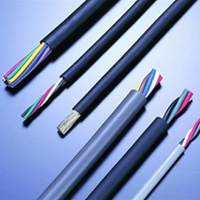
UL electron wire
Focus on production and sales
UL electron wire
Focus on production and sales+86-0769-85704089
The technological evolution of sensors breaking free from cable constraints is unfolding along two completely different paths: one is the wireless path of completely "cutting off" cables, and the other is the innovative path of transforming "existing lines" to achieve multi energy in one line. These two paths have their own emphasis on technical principles and application scenarios, jointly driving the paradigm shift of sensing systems.
1、 Wireless Path: The Leap from "Passive" to "Self Powered"
Wireless technology has completely eliminated cables for sensors, but the core challenge lies in balancing power supply and signal transmission distance. Traditional wireless solutions such as Wi Fi and Bluetooth, although having considerable transmission distances, require battery power and face the maintenance challenge of frequent battery replacement.
1. Battery free wireless sensing: a breakthrough in RFID technology
The battery free wireless sensor system is powered by an external RF reader, and sensor tags can function without the need for built-in batteries. This technology has unique advantages in infrastructure inspection at high altitudes or steep slopes, which can avoid the high scaffolding costs required for traditional visual inspections.
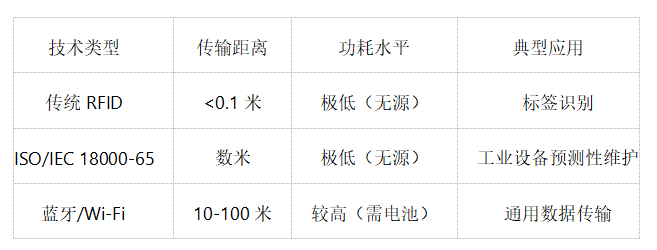
In February 2026, the ISO/IEC 18000-65 international standard, jointly proposed by Keio University, Panasonic Corporation, and other institutions in Japan, was officially released. This is the first RFID standard that supports synchronous continuous data collection using battery free sensors.
Technical highlights:
Adopting backscatter communication, with extremely low power consumption (about 10 µ W)
Assign independent frequency channels to each wireless terminal to achieve multi-sensor synchronous acquisition
Support continuous monitoring of time series data such as vibration, strain, temperature, etc
Technical comparison:
2. Self powered perception and communication integration: from "energy harvesting" to "symbiosis"
If battery free RFID still requires external card reader power supply, then self powered technology enables sensors to achieve true energy autonomy - directly obtaining energy from environmental mechanical energy and combining signal generation and wireless transmission.
Breakthrough: The self powered triboelectric wireless sensing and communication integration technology jointly developed by Chongqing University and the Chinese Academy of Sciences team was published in the journal Nature Sensing in 2026. This technology is based on the principle of triboelectric nanogenerator (TENG), which directly converts the mechanical energy generated by the movement of the human arm into electrical energy, and generates discrete pulse signals, which are wirelessly transmitted to control the synchronous response of the remote robotic arm.
Core innovation:
Breaking the "supply perception communication" separate architecture: integrating the three major functions into a single physical link
Communication naturally triggered by events: bidding farewell to the traditional communication mode of continuous power consumption
Transmission distance up to 100 meters: achieved through breakdown discharge mechanism
The viewpoint article in the same period of Nature Sensing pointed out that "self powered is no longer an independent energy supply module, but has become a part of the information generation mechanism". This paradigm shift means that communication will shift from a sustained energy burden to a process naturally triggered by interactive events.
3. Wi Fi sensing: turning the "signal" itself into a sensor
The most disruptive idea may be to use existing Wi Fi signals in the environment to achieve perception without the need for specialized sensors. The research conducted by the Network and Cloud Computing team at Tianjin University shows that by analyzing the subtle changes in Wi Fi signals caused by human activities, one can perceive a person's location, status, and behavior.
Breakthrough of two major bottlenecks:
Deployment challenge: Transforming the robotic vacuum cleaner into an "automatic collector" of environmental information, synchronously constructing physical space maps and Wi Fi signal maps during the cleaning process, with a positioning accuracy of 0.1 meters
Accuracy challenge: Establish a new theoretical model to understand the propagation pattern of Wi Fi signals in real home environments (with occlusion and reflection), and reduce positioning errors by about 42% compared to the previous optimal method This technology enables smart homes to evolve from "following instructions" to "proactive care" - the lights automatically turn off when you fall asleep, without any instructions or wearing devices.
2、 Wired Innovation Path: Empowering Existing Lines to Carry More Potential
Not all scenarios are suitable for wireless solutions. In industrial environments with severe metal shielding or vehicles with complete wiring harnesses, rewiring is costly. At this point, 'renovating existing lines' becomes a better solution.
1. Power line communication: Let power lines also serve as "data lines"
A research team from Krems University in Austria has developed a low-cost PLC modem that can transmit sensor data through existing wiring harnesses at a rate of 19.2 kBit/s. This is particularly valuable in vehicle modification scenarios - sensor data communication can be achieved using the vehicle's existing cable network without the need to install any new cables.
2. Antenna sensors: the "dual identity" of communication and perception
Antenna sensors unify wireless communication and environmental perception into the same physical structure. When external stimuli (strain, temperature, humidity) change the dielectric environment around the antenna, the resonant frequency, return loss, or radiation mode of the antenna will change accordingly. By monitoring these parameter changes, the perception signal can be quantified.
Key advantages:
Completely passive operation, no battery required
Compatible with flexible materials and can be integrated into wearable devices
Suitable for scenarios such as implantable medical devices and structural health monitoring
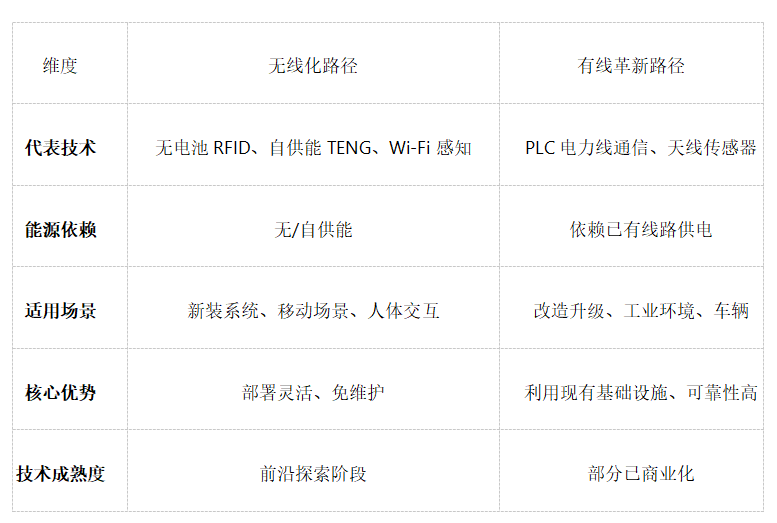
3、 Comparison and Selection of Two Paths
Future Prospects
Sensors are breaking free from the constraints of "wires" and moving from the primary form of "cutting off cables" to the advanced paradigm of "energy information collaborative conversion and transmission". The noteworthy trends include:
Deep Integration of AI and Wireless Sensing: Machine Learning Algorithms Used for Network Optimization, Node Deployment, and Signal Analysis
Breakthroughs in Materials Engineering: 3D Printing, Flexible Bases, and Nanomaterials Drive Further Miniaturization and Intelligence of Sensors
The promotion of standardization: The release of international standards such as ISO/IEC 18000-65 has cleared obstacles for the industrialization of battery free wireless sensing
It can be foreseen that future sensing systems will no longer be independent functional modules, but intelligent nodes that integrate into the environment, operate autonomously, and respond on demand - whether they communicate through invisible radio waves or cleverly utilize every existing cable.
 Dongguan Futai Electronic Technology Co., Ltd. All Rights Reserved
Contact information
Mr. Li: +86-18688316819